Author Archives: Kavuklis

Register for participation in the HistoryCampus Berlin: “Look back and think forward“

Be part of it! Come to the HistoryCampus Berlin
Register for participation in the HistoryCampus now until 17 February 2014! / 100 Years World War One

bpbFrom 7 to 11 May 2014, up to 500 young interested people from all over Europe will meet at the HistoryCampus at the Maxim Gorki Theatre in Berlin Mitte. The HistoryCampus is the central core of the history festival Europe 14I14 which will take place in Berlin in May 2014.
Are you between 18 and 25 years of age? Are you interested in history and politics? Are you keen to find answers together with other young Europeans to the question what the First World War means to you personally and to your generation? Register until 17 February 2014 for participation in the event!

The HistoryCampus provides a space to discover how 1914 and the First World War relate to you and your life here and now. At the on-site workshops you will discuss and do research, shoot films and edit sounds, act out roles and perform, write scripts and narrate your story and so much more. The workshops will be accompanied by a diverse spectrum of activities that offer you an unusual approach to historical as well as contemporary issues. The activities include a broad cultural programme with performances, concerts, exhibitions, theatre and readings, thematic explorations of the city and much more. Alongside, you can enjoy a great campus atmosphere and the opportunity to meet many interesting young people from all over Europe!

After your successful application, you will be invited by the organisers to join the HistoryCampus in May. You will travel to Berlin for free, will be accommodated at a central hostel and will be part of the campus activities for three days.

Please find further information on the application, participation and the workshop programme at www.europe1414.de.

During your online registration, please use the registration code bpb.

Interested Berlin visitors are invited to “look back and think forward“ together with the organisers and with you as a HistoryCampus participant. The history festival Europe 14I14 will take place in Berlin in May on occasion of the centenary of the beginning of the First World War in 2014. Current information about the programme is available at www.europe1414.de, which is continuously updated.
The Federal Agency for Civic Education is organising the festival together with the Koerber-Foundation and the Robert Bosch Stiftung, in cooperation with the Maxim Gorki Theatre Berlin and various partners and supporters.

Information at a glance:

HistoryCampus Berlin
Date: 7 May to 11 May 2014
Venue: Maxim Gorki Theatre, Am Festungsgraben 2, 10117 Berlin

For further information please contact:

Federal Agency for Civic Education
Nina Schillings
phone    +49 (0) 228 99515-265
fax         +49 (0) 228 99515-309
email: Nina.Schillings@bpb.de

likeminds: german-turkish junior expert initiative

EA BerlinJETZT BEWERBEN!!
Bewerbungsschluss: 09. Februar 2014

likeminds” ist ein binationales Begegnungs- und Besucherprogramm in Deutschland und in der Türkei. Es verbindet junge Leistungsträger, bringt sie in einen themenorientierten Dialog und vernetzt sie fachlich und persönlich.
Das diesjährige Thema lautet ”Getting involved: Social Movements and Participation’‘.

Das Programm besteht aus drei Komponenten:
– ein nationaler Workshop im Heimatland (inkl. Videokonferenz) vom 21. – 23. März 2014
– eine tour d`horizon in Berlin und Leipzig vom 01. – 06. Juni 2014
– eine tour d`horizon in Istanbul und Izmir vom 07. – 12. Oktober 2014

Bewerbungsformular sowie weitere Informationen unter http://www.eab-berlin.de/likeminds.296.0.html

European Citizens’ Initiative: Ombudsman invites feedback

The European Ombudsman, Emily O’Reilly, invites organisers of European Citizens’ Initiatives (ECIs), civil society organisations, and other interested persons to examine how well the ECI is working. The ECI allows a group of one million EU citizens to call on the European Commission to propose new EU legislation.
The deadline for contributions to the Ombudsman’s consultation is 31 March 2014.

How well do the ECI procedures work?

European Citizens InitiativeThe European Citizens’ Initiative began in April 2012. In December 2013, the first completed ECI was submitted to the Commission, with support from more than one million European citizens in at least seven Member States. The “Right2Water” initiative proposes new EU legislation to make member state governments provide their citizens with sufficient and clean drinking water and sanitation.

The Ombudsman opened the investigation on her own initiative. She wants to see what the Commission has done to implement the ECI and will make recommendations to increase the effectiveness of the process, if necessary. Specific issues for scrutiny include the effectiveness of the Commission’s software for collecting signatures online, how the contacts with the different national authorities work, and possible protection of privacy concerns. She has also invited ideas on possible future changes to the ECI Regulation. Once the Ombudsman has collected the ECI feedback, she will ask the European Commission to respond.

The Ombudsman’s set of questions is available at: http://www.ombudsman.europa.eu/en/cases/correspondence.faces/en/53104/html.bookmark

European Film Gateway 1914

The European Film Gateway 1914 (EFG1914) is a digitisation project focusing on films and non-film material from and related to World War I.  It started on 15 February 2012 and runs for two years. 26 partners, among them 21 European film archives, are working towards the following  main goals:

  • To digitise 661 hours of film and ca. 5.600 film-related documents on the theme of the First World War
  • To give access to the material through the European Film Gateway and Europeana
  • To build a virtual exhibition using selected objects digitised in EFG1914

EFG1914
EFG1914
covers all the different genres and sub-genres relevant in that time: newsreels, documentaries, fiction films, propaganda films. Moreover, EFG1914 will also give access to anti-war films that were mainly produced after 1918 and which reflect the tragedies of the 1910s.

Read more about the projectIf you are interested to see films and find out more about the available collections, please visit:  THE EUROPEAN FILM GATEWAY – FIRST WORLD WAR FILMS

Martin Schulz fordert Veränderungen innerhalb der Europäischen Union

Der Präsident des Europäischen Parlaments sprach im Bonner Posttower

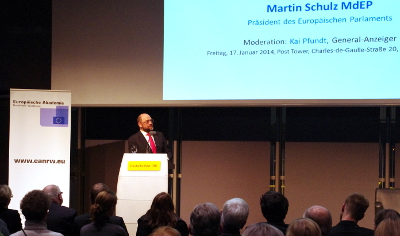
Auf Einladung der Europäischen Akademie Nordrhein-Westfalen und des Kreisverbandes Bonn / Rhein-Sieg der Europa-Union sprach am 17.01.2014 der Präsident des Europäischen Parlaments, Martin Schulz, im Bonn Posttower zum Thema „Europa vor der Wahl – quo vadis EU?“

Martin SchulzBegrüßt durch den Kreisvorsitzenden der Europa-Union, Axel Voss MdEP, betonte Schulz einleitend in seinem rund einstündigen freien Vortrag, dass sich die EU ändern müsste. Die Bürgerinnen und Bürger stünden zwar mehrheitlich nicht skeptisch der europäischen Integrationsidee gegenüber, zeigten sich aber verstärkt kritisch bis ablehnend gegenüber der Europäischen Union, ihrer Struktur sowie der fehlenden Transparenz der europäischen Politik.

Martin Schulz bemängelte zunächst vor allem, dass sich in der Zeit der Krise der Europäische Rat, also das Treffen der Staats- und Regierungschefs, zu einer europäischen Regierung entwickelt habe. Dies sei im Sinne einer Vergemeinschaftung von Politik nicht richtig. Dafür bedürfe es vielmehr einer vom Europäischen Parlament legitimierten europäischen Exekutive.

Hart ins Gericht ging Schulz auch mit der Europäischen Kommission unter Jose Manuel Barroso. Vertreten durch die Kommission müsse Brüssel nicht die Regelung jeder politischen Frage an sich reißen. Vielmehr stünde es an, das Subsidiaritätsprinzip greifen zu lassen, also die Entscheidungen über politische Fragen wieder dort zu treffen, wo sie wegen ihrer Gründe und Auswirkungen am ehesten getroffen werden könnten, national, regional oder durchaus auch lokal.

Martin Schulz, der nach der kommenden Wahl zum Europäischen Parlament Präsident der Europäischen Kommission werden will, beklagte auch, dass derzeit die Kommission gegenüber dem Europäischen Parlament zu wenig rechenschaftspflichtig sei. Das EP könne zwar die Kommissare vor das Parlament zitieren, nicht aber die Generaldirektoren als die eigentlichen Leiter des riesigen Verwaltungsapparats der Kommission.

Auch die zahlenmäßige Größe der Kommission – derzeit 28 Kommissare – fand Schulz überdenkenswert. Zum Nachdenken müsste auch anregen, dass mit der Kommission derzeit die europäische Exekutive das alleinige gesetzgeberische Initiativrecht besitze.

Schulz redete in seinem Vortrag der Überzeugung das Wort, dass der Präsident der Europäischen Kommission – auch um einer starken Position gegenüber den Staats- und Regierungschefs willen – vom Europäischen Parlament gewählt werden müsste. Dafür müssten auch die Wahlen zum Europäischen Parlament personalisiert werden. Es wäre gut, wenn die europäischen Parteien mit jeweils einer Person an der Spitze in den Wahlkampf gingen, die bei ausreichendem Wahlerfolg dann auch Kommissionspräsident werden wollten. Er ginge davon aus, so Schulz weiter, dass die Christdemokraten Jean-Claude Juncker zum Spitzen und somit seinem Gegenkandidaten benennen würden. Auf eine streitbare Auseinandersetzung mit Juncker im Wahlkampf freue er sich.

Der Vortrag von Martin Schulz sowie die anschließende Diskussion unter der Moderation von Kai Pfundt vom Bonner General-Anzeiger wurden zum Schluss nicht nur von Richard Stock, dem Vorsitzenden der Europäischen Akademie Nordrhein-Westfalen mit Dank quittiert, sondern fanden auch langanhaltenden Applaus der rund 300 Zuhörerinnen und Zuhörer.

Die Erwartungen der Veranstalter wurden nach Äußerungen des Leiters der Europäischen Akademie, Hanns Christhard Eichhorst , mehr als erfüllt. Man habe sich noch vor Beginn des eigentlichen Europawahlkampfes von Schulz Denkanstöße zur weiteren Entwicklung der Europäischen Union erhofft. Diese Erwartungen habe Schulz mehr als erfüllt und den verantwortlichen Politikern in der EU umfangreiche Handlungsnotwendigkeiten aufgezeigt.

Lesen Sie hierzu auch den Bericht des Bonner General Anzeiger.