Author Archives: Kavuklis

European Online Education and Training Monitor 2013

Education and Training Monitor 2013

Education and Training Monitor 2013

The 2013 Education and Training Monitor provides a picture of each country’s progress in relation to specific benchmarks and indicators, and highlights the latest policy developments and analysis.

At the request of the Council, the Education and Training Monitor is an annual report presented every autumn by the Commission, setting out, in a succinct document, progress on the ET 2020 benchmarks and core indicators, including the Europe 2020 headline target on education and training. The Education and Training Monitor illustrates the evolution of education and training systems across Europe, with a particular focus on the country-specific recommendations adopted in the field of education and training, and contributes to the analytical basis for the next European Semester.

The second annual Education and Training Monitor is accompanied by 28 individual country reports and an online visualisation tool.

Green light for Erasmus+

Erasmus+Erasmus+, the new EU programme for education, training, youth and sport, due to begin in January, was approved by the European Parliament on November 19th.

Erasmus+ has three main targets:

  • two-thirds of the budget is allocated to learning opportunities abroad for individuals, within the EU and beyond;
  • the remainder will support partnerships between educational institutions, youth organisations, businesses, local and regional authorities and NGOs,
  • as well as reforms to modernise education and training and to promote innovation, entrepreneurship and employability.

The new Erasmus+ programme combines all the EU’s current schemes for education, training, youth and sport, including the Lifelong Learning Programme (Erasmus, Leonardo da Vinci, Comenius, Grundtvig), Youth in Action and five international cooperation programmes (Erasmus Mundus, Tempus, Alfa, Edulink and the programme for cooperation with industrialised countries). This will make it easier for applicants to understand the opportunities available, while other simplifications will also facilitate access.

Read the full EU press release

European Parliament approves EU’s long-term budget (MFF) 2014-2020

EU's long-term budget: how it all adds up

EU’s long-term budget: how it all adds up

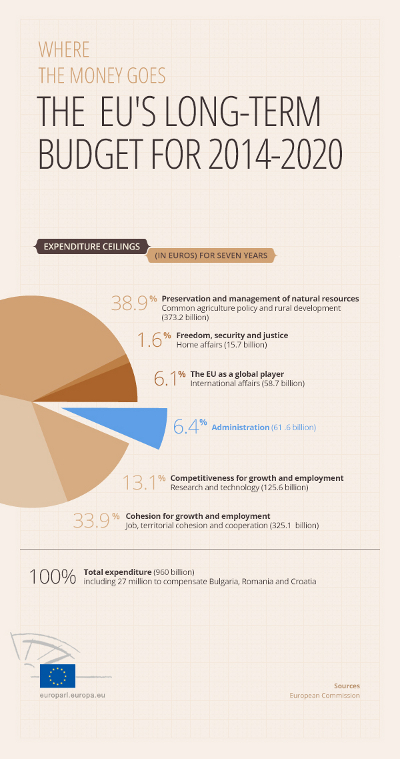
Doing more with less: the agreement for the EU’s budget for 2014-2020, which was approved by MEPs on 19 November, will for the first time see funding decline compared to the previous long-term budget. However, this does not mean that the EU will be any less ambitious. In talks with the Council and the Commission EP negotiators have pushed hard to ensure the best use of each available euro. For more about how the money will be invested, check out the infographic.

The Parliament has secured an agreement allowing unused funds to be transferred to the following year or to be reinvested in other parts of the budget. No less than 94% of the EU-budget is re-invested to benefit businesses and people in all member states.

The budget will be reviewed in 2016, giving the next Parliament starting its term in 2014 the opportunity to have its say. Member states also agreed on the setting up of a working group to research how revenue sources could be modernised in order to reduce member states’ contribution to the EU budget.

EUCIS-LLL Manifesto – Building together the future of Learning

EUNET supports the Manifesto develop by the European Civil Society Platform on Lifelong Learning (EUCIS-LLL).

eucisThe 2014 European elections will provide the right momentum to think about the future of learning in Europe. The current economic and social crisis gave a new impetus to deeper cooperation in education and training with a high focus on growth and employment while at the same time austerity measures have weakened our educational systems. EUCIS-LLL believes that a sustainable investment should be made in learning as essential for our social model, in line with their prioritization at EU level.
Poor access to lifelong learning limits people’s ability to access quality jobs and participate fully in society. We need a vision to ensure our education and training systems deliver better for economic development, social and civic participation, personal fulfilment and well-being. EUCIS-LLL calls MEPs to consider three top priorities and a set of 12 policy recommendations for lifelong learning in its Manifesto “Building together the future of Learning”.

The Manifesto will be officially launched and discussed by MEPs during our Lifelong Learning Week 2013 in a roundtable in the European Parliament on 3 December (9h30 – 13h00). See draft programme and register before 25 November here.

ERASMUS+ grants for students, apprentices and volunteers

Belga/DPA/J.Woitas

Belga/DPA/J.Woitas

The new €14 billion Erasmus+ education programme for 2014-2020, approved by the Culture and Education Committee last week, will enable over 5 million young people to go to other countries to study, train and join in voluntary activities including sport.
In future, it will fund scholarships for non-university students, and back loan guarantees schemes for master’s degree ones. It should also ensure that grants are paid faster.

“We have a very useful grouping of hitherto separate programmes, which nonetheless retains the characteristics of each. We have obtained many very useful results in the negotiations and I hope that this programme will be as successful as in the past” said rapporteur Doris Pack (EPP, DE).

Erasmus+ aims to help young people of 13 to 30 years old to get mobile in order to learn, study and acquire professional skills and aptitudes in a country other than their country of origin. In the field of education, training and youth, it will bring together Comenius, Erasmus, Erasmus Mundus, Leonardo da Vinci (vocational training), Grundtvig and Youth in Action. It also introduces sport, for the first time in a European programme. The existing brand names will be kept, as they are well known to the public.

Exchanges of leaders of youth clubs and volunteer activities will be eligible for Erasmus+ funding.

Erasmus+ funding will also be available for cross-border mobility of young people and volunteers in the field of sport, and in particular for activities that help to combat violence, discrimination or doping. Non-profit sporting events that involve several countries could also get EU funding.

Loan guarantees for master’s degree students

Through Erasmus+, the EU will guarantee loans of up to €12,000 (for one year) or €18,000 (for two years) to students who wish to pursue Master degree in another country. This new system will in no case replace grant or loan systems that already exist or could be established at national level, MEPs stressed.

Funding better tailored to students needs

The text says that grants should reflect the cost of living in the host country and that member states should exempt them from any taxes or social levies. Unified management of the programme would also help to speed up the payment of grants to beneficiaries.

If approved by the EP at the November plenary and then by the Council, Erasmus + would take effect on 1 January 2014.