Category Archives: General

EU report “Cutting red-tape in Europe”

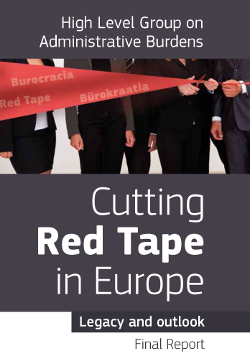
Cutting red tapeOn 14th October in Brussels Edmund Stoiber presented the final report by the High Level Group on Administrative Burdens that he has led to advise the European executive.

According to the conclusions of the former Bavarian Prime Minister it would be necessary to exempt SMEs from industrial rules “as much as possible”. He also advised the future Commission led by J-C Juncker to undertake further administrative reform to reduce red-tape which would lead to savings of 41 billion euro per year and convince the UK to remain in the EU.

Final report "Cutting red-tape in Europe"

European Portfolio for youth leaders and youth workers

Portfolio_en-1The European Portfolio for youth leaders and youth workers is an initiative of the Council of Europe in cooperation with experts and partners such as the European Commission and the European Youth Forum. It provides youth leaders and youth workers in Europe, volunteers or professionals, with a tool which can help them identify, assess and describe their competencies based on European quality standards.

In using this portfolio, youth leaders and youth workers will not only contribute to the recognition of their experience and skills but also to efforts to increase the recognition of youth work and non-formal education and learning.

Youth work in Europe covers many different realities. This I why this portfolio has been tested in many countries and has been designed to enable users to make adaptations if necessary – for instance, by adding competencies specific to their circumstances.

European Portfolio for youth leaders and youth workers
Europäisches Portfolio für Jugendleiter/innen und Jugendbetreuer/innen
Portfolio européen pour travailleurs et animateurs de jeunesse
CoE: Mini-Compendium on non-formal education

European Commission “enlargement package” 2014

web-banner-2014The European Commission adopted the annual “enlargement package” – a series of documents which explain its policy regarding the EU’s enlargement and presents the progress achieved by each candidate country.

Hence the Commission has assessed the progress made in 2013 by the countries of the Western Balkans which want to join the EU and Turkey. It has also looked into the challenges that remain.
The report includes an  annual enlargement strategy document which sets priorities for the candidate countries in terms of their bid to integrate the EU, it also contains “progress reports” in which the Commission presents an assessment of each candidate country and each potential candidate in 2013

Albania Progress Report 2014
Bosnia and Herzegovina Progress Report 2014
The former Yugoslav Republic of Macedonia Progress Report 2014
Kosovo* Progress Report 2014
Montenegro Progress Report 2014
Serbia Progress Report 2014
Turkey Progress Report 2014

EP – European Citizens Initiative. First lessons for implementation

European Citizens InitiativeA study by the European Parliament’s Policy Department for citizens’ rights and constitutional affairs, this study identifies difficulties faced by organisers when setting up and running a European Citizens’ Initiative (ECI). It analyses possible solutions and proposes recommendations to improve the ECI as an effective tool for participatory democracy in the EU.
The aim is to propose measures to ensure a straightforward ECI process with less costs and burdens for EU citizens.
The ultimate goal is to define concrete actions to empower EU citizens to actively participate in shaping the future of Europe.

European Citizens’ Initiative – First lessons of implementation

OECD – Education at a Glance 2014

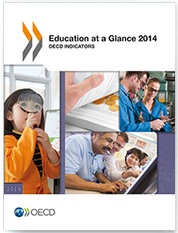
Education at a glance 2014This annual publication is the authoritative source for accurate and relevant information on the state of education around the world.

Featuring more than 150 charts, 300 tables, and over 100 000 figures, it provides data on the structure, finances, and performance of education systems in the OECD’s 34 member countries, as well as a number of partner countries.

What’s new in the 2014 edition?

  • New indicators on private institutions, on what it takes to become a teacher, and on the availability of, and participation in, professional development activities for teachers.
  • Data from the 2012 Survey of Adult Skills, on attainment, employment, intergenerational education mobility, earnings, and social outcomes related to skills proficiency.
  • Data from the 2013 OECD Teaching and Learning International Survey (TALIS) and the 2012 OECD Programme for International Student Assessment (PISA) in several indicators.
  • Analysis of the impact of the recent economic crisis on the interplay among educational attainment, employment, earnings and public finance.
  • More in-depth information related to upper secondary completion rates and the types and use of student loans.
  • For the first time, data from Colombia and Latvia.

Highlights:

Education at a Glance 2014

Full report Education at a Glance 2014