Category Archives: General

Open Letter to EU Heads of States and Governments on the future of the Europe for Citizens programme

Europe for CitizensAt a time when citizens are expressing an ever growing distrust in EU Institutions and policies, and in spite of the widely propagated ideas (by the EU Institutions) that the EU has citizens at its heart and that civil society is valued as a crucial partner, the European Council seems to be expressing an opposing view.

The EU supports citizens by co-funding civil society organisations’ general budgets and specific projects through the ‘Europe for Citizens’ programme. These activities and programmes take the form of transnational partnerships, European civil society networks, citizens’ events, town twinning projects, and remembrance initiatives.

However, at the European summit in March 2013, the Heads of State and National Governments demanded a reduction of 23% of the programmes budget over the next seven years.
We find it unacceptable that while the EU celebrates the European Year of Citizens in 2013 (with the lowest ever dedicated budget for a European Year), the Council proposes to deny the ‘Europe for Citizens programme’ almost one quarter of its already extremely small budget.

We ask the Council to reverse the proposed budget reductions to continue to work in partnership with the EU institutions and other stakeholders to pursue the European building process so that it fully meets the expectations of the people of the European Union for a stronger, more cohesive Europe.

Read the full open letter and share it!

[Download not found]

Keep Your passenger rights at hand, everywhere

The EU is the first area in the world with a full set of passenger rights for all modes of transport. Especially good to know if you need to get somewhere by plane, coach or boat!

Vacation time is coming up and passengers stranded at airports or awaiting missing luggage may now use a mobile application for free to check their rights immediately and on the spot.

The application, launched by the European Commission, is available on four popular mobile platforms: Apple iPhone and iPad, Google Android, RIM Blackberry and Microsoft Windows Phone 7.

Download page

Eurobarometer “European Youth: Participation in Democratic Life”

With regard to our project “First-Time-Voters 2014” the new Eurobarometer gives a detailed view on young EU citizens’ participation in society, with special reference to attitudes towards participation in elections and intentions to participate in the European elections in 2014.

The survey examined the following issues:

  • young people’s involvement in a range of groups and clubs such as sports clubs, youth organisations and cultural organisations.
  • young people’s participation in political elections at the local, regional or national level
  • young EU citizen’s awareness and intended participation in forthcoming European elections
  • respondents’ awareness of how the members of the European Parliament are elected
  • probability of voting in the European elections in 2014
  • reasons behind their expected level of participation in the 2014 European elections.

 Flash Eurobarometer 375

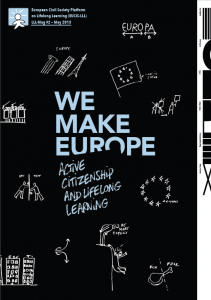
LLL-Mag#2 “We Make Europe”

LLL-Mag2-211x300The European Civil Society Platform on Lifelong Learning – EUCIS-LLL has just published the second edition of its LLL-Mag on “We Make Europe, Active Citizenship and Lifelong Learning“.

This magazine captures some of the sparks of civic engagement and aims to contribute to the debates taking place in the context of the European Year of Citizens 2013.
Its purpose is bringing together various perspectives and experiences in order to show the wealth and dynamism but also the limitations and pitfalls of what is active European citizenship nowadays.

EU Citizenship report 2013

citizenship_report_newsroomThe European Commission has unveiled a new push to reinforce EU citizens’ rights with a series of actions to tackle obstacles that citizens still face in their everyday life.
The 2013 EU Citizenship Report sets out 12 concrete ways to help Europeans make better use of their EU rights, from looking for a job in another EU country to ensuring stronger participation in the democratic life of the Union.

The EU Citizenship Report 2013 announces 12 new actions in six areas to strengthen citizens’ rights:

  1. Removing obstacles for workers, students and trainees in the EU

  • by looking into extending the right of jobseekers to receive unemployment benefits from their home country while they are looking for a job in another EU member state beyond the current mandatory three months to increase the mobility of workers; and
  • by setting out a quality framework for traineeships that specifies the rights and obligations of the parties making sure that traineeships are not used as a form of ‘unpaid employment’
  1. Cutting red tape in the Member States

  • by facilitating the acceptance of identity and residence documents when citizens want to travel or have to prove their identity in another EU country, including through optional uniform European documents that citizens could use in all EU countries; and
  • by making it easier to recognise roadworthiness certificates for cars cross-border in the EU
  1. Protecting the more vulnerable in the EU

  • by developing an EU disability card to be mutually recognised across the EU making sure that the 80 million disabled people can also take advantage of the benefits that come with national cards (for example access to transport, tourism, culture and leisure) when exercising their right to free movement; and
  • by proposing a set of laws to further strengthen citizens’ procedural rights, especially those of children and vulnerable citizens, when they are suspected or accused of a crime
  1. Eliminating barriers to shopping in the EU

  • by improving rules to settle cross-border disputes over small amounts when buying products online or in another EU country; the European Small Claims procedure can help consumers get their money back swiftly; and
  • by working on an online tool that makes the purchase of digital products more transparent and that allows citizens to compare deals cross-border

  1. Promoting the availability of targeted and accessible information about the EU

  • by making e-training tools available to local administrations and providing citizen-friendly information about who to turn to to solve their problems.

  1. Strengthening citizens’ participation in the democratic process

  • by working on ways to enable EU citizens to keep their right to vote in national elections in their country of origin. The practice in some Member States of depriving their citizens of their right to vote once they move to another EU country effectively is tantamount to punishing citizens for having exercised their right to free movement.

The EU Citizenship report 2013 focuses again on individual rights. All topics mentioned above are important for part or all citizens of Europe, but European Citizenship is more than individual rights.

Please read the manifesto (available in nearly all EU languages) of the European Year of Citizens Alliance to get a broader understanding of EU Citizenship.