Author Archives: Kavuklis

Imagining the learning community of tomorrow

lllplatform annual conferenceOur member Centrum pre európsku politiku is official partner of the conference “Imagining the learning community of tomorrow” organised by the Lifelong Learning Platform.
The LLLPlatform annual conference takes place from May 31st to June 1st 2016 in Bratislava.

Gathering some 150 experts and practioners in education from all over Europe, the conference will be the opportunity to share practices from all over Europe to learn from each other and build creative solutions. It will encourage participants to build partnerships to meet Europe’s most pressing challenges.

Discover the Programme, Speakers, how Architecture and Education will get together to design the learning community of tomorrow on the designated conference website.

Register today and get local, student or early bird ticket.

Overview of education policy developments in Europe following the Paris Declaration of 17 March 2015

Overview of education policy developments in Europe following the Paris Declaration of 17 March 2015A year ago, in response to extremist violence and terrorist attacks in Europe, the EU Education
Ministers and Commissioner Navracsics adopted the Paris Declaration on ‘Promoting citizenship and the common values of freedom, tolerance and non-discrimination through education’. It reaffirmed Europe’s determination to stand shoulder to shoulder in support and safeguard of the fundamental values that lie at the heart of the EU: respect for human dignity, freedom, democracy, equality, the rule of law and respect for human rights.

One year on, how have European countries addressed the Paris Declaration objectives in their education policies? This new Eurydice leaflet will provide you with a short overview of recent education policy developments in European countries since the adoption of the Paris Declaration.

Overview of education policy developments in Europe following the Paris Declaration

Report by the European Parliament: Learning EU at school

EU educationThe Culture and Education Committee of the European Parliament published a new report on learning EU at school, underlining the increasing importance of a European dimension in education across the different disciplines, levels and forms of education, while stressing the need for a broad and in-depth understanding of the concept which takes into account its complex, dynamic and multi-layered nature, with learning about the EU at school being a crucial component.

In its report the committee points out how important education about the EU is – not only in schools, but for citizens of all ages. The report is a strong support for the activities of our members, who realized decades ago that an EU dimension in education is crucial to help citizens better understand – and reconnect them with – the EU and the need of understanding and promoting attachment to the fundamental values of the European Union.

The report is available below for download in English, French and German. It’s worth reading!

EP - Learning EU at school
PE - Apprendre l'Union européenne à l'école
EP - Erwerb von Kenntnissen über die EU an Schulen

Youth work and non-formal learning

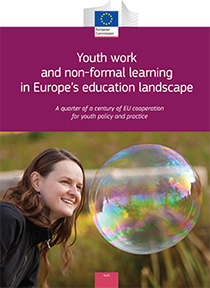
Youth work and non-formal learning in Europe’s education landsThe publication marks a quarter of a century of EU youth programmes accompanied by EU youth policy. It brings together some of the thinking that inspires – and is inspired by – EU actions for youth to encourage debate about what youth work and non-formal learning can contribute to European education.

It reviews EU cooperation in the field from different perspectives, points to successes and sets out possible future scenarios, particularly in the context of the Erasmus+ programme

Youth work and non-formal learning

Apply now for the Youth Democracy Award 2016!

Youth Democracy AwardThe German Federal Agency for Civic Education/bpb will continue awarding the “Youth Democracy Award” in 2016. This year, the focus is on projects which aim to raise awareness against right wing populism in everyday life.

Applications can be submitted until April 15, 2016.

These days, the democratic system is being challenged in multiple ways: anti-democratic slogans, xenophobia and electoral success of right wing parties have surfaced not only in Germany but in many European countries. This is why the bpb would like to honour a project in 2016, which sends a signal against this rising tendency and demonstrates that respect and tolerance are important values that need to be preserved.

The winners will be selected by a youth jury consisting of 15 students aged 16 to 27 from all over Germany. They will discuss and honour the project which has the most convincing and sustainable impact in regard to the competition theme. Applicants will be informed about the decision in late July 2016.

Please visit this website for further information as well as the application form.

The winner project will be honoured with 3000 Euro.