Category Archives: General

Eurobarometer on European Union Citizenship

citizenship_report_newsroomThe European Commission has published new Eurobarometer on EU citizenship and the electoral rights that come with it.

The survey shows that more Europeans (87%) than ever are familiar with their status as EU citizens. The report also shows that a similar number (88%) thinks that the EU should give citizens a stronger voice in democratic decision-making, an advocacy long defended by the European Civic Forum and other civil society organisations.

The respondents also showed their interest in playing a more active role in the European political life, which would not be limited to European elections. Online consultations and other dialogue mechanisms were notably quoted several times.
The Flash Eurobarometer on EU citizenship was conducted in October 2015 among 26,555 citizens in all 28 Member States. The European Commission took the opportunity to reiterate its commitment to ensuring that EU citizenship rights translate into concrete added-value for European citizens.

Eurobarometer on EU citizenship

Imagining the learning community of tomorrow

lllplatform annual conferenceOur member Centrum pre európsku politiku is official partner of the conference “Imagining the learning community of tomorrow” organised by the Lifelong Learning Platform.
The LLLPlatform annual conference takes place from May 31st to June 1st 2016 in Bratislava.

Gathering some 150 experts and practioners in education from all over Europe, the conference will be the opportunity to share practices from all over Europe to learn from each other and build creative solutions. It will encourage participants to build partnerships to meet Europe’s most pressing challenges.

Discover the Programme, Speakers, how Architecture and Education will get together to design the learning community of tomorrow on the designated conference website.

Register today and get local, student or early bird ticket.

Overview of education policy developments in Europe following the Paris Declaration of 17 March 2015

Overview of education policy developments in Europe following the Paris Declaration of 17 March 2015A year ago, in response to extremist violence and terrorist attacks in Europe, the EU Education
Ministers and Commissioner Navracsics adopted the Paris Declaration on ‘Promoting citizenship and the common values of freedom, tolerance and non-discrimination through education’. It reaffirmed Europe’s determination to stand shoulder to shoulder in support and safeguard of the fundamental values that lie at the heart of the EU: respect for human dignity, freedom, democracy, equality, the rule of law and respect for human rights.

One year on, how have European countries addressed the Paris Declaration objectives in their education policies? This new Eurydice leaflet will provide you with a short overview of recent education policy developments in European countries since the adoption of the Paris Declaration.

Overview of education policy developments in Europe following the Paris Declaration

Report by the European Parliament: Learning EU at school

EU educationThe Culture and Education Committee of the European Parliament published a new report on learning EU at school, underlining the increasing importance of a European dimension in education across the different disciplines, levels and forms of education, while stressing the need for a broad and in-depth understanding of the concept which takes into account its complex, dynamic and multi-layered nature, with learning about the EU at school being a crucial component.

In its report the committee points out how important education about the EU is – not only in schools, but for citizens of all ages. The report is a strong support for the activities of our members, who realized decades ago that an EU dimension in education is crucial to help citizens better understand – and reconnect them with – the EU and the need of understanding and promoting attachment to the fundamental values of the European Union.

The report is available below for download in English, French and German. It’s worth reading!

EP - Learning EU at school
PE - Apprendre l'Union européenne à l'école
EP - Erwerb von Kenntnissen über die EU an Schulen

Youth work and non-formal learning

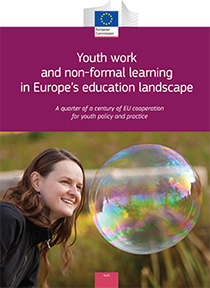
Youth work and non-formal learning in Europe’s education landsThe publication marks a quarter of a century of EU youth programmes accompanied by EU youth policy. It brings together some of the thinking that inspires – and is inspired by – EU actions for youth to encourage debate about what youth work and non-formal learning can contribute to European education.

It reviews EU cooperation in the field from different perspectives, points to successes and sets out possible future scenarios, particularly in the context of the Erasmus+ programme

Youth work and non-formal learning