Category Archives: General

Survey on European Union Financial Regulations

Civil Society EuropeThrough its working group on Civil Society Organisation recognition, Civil Society Europe has prepared a survey to collect NGOs views on the review of the financial regulations and rules of application of the European Union.
The questions are based on the European Commission open public consultation.

The purpose of the survey is to prepare some recommendations for responses to the European Commission consultation based on your responses, that each organisation can use for their individual input.

You can respond by May 8th. Results will be circulated  by May 13th, in order to feed in  your responses to the Commission questionnaire (deadline May 27th).

The survey does not cover all questions proposed by the Commission, but a selection of those that are more related to the work of NGOs. We have also added some further issues such as the eligibility of in-kind contributions as co-funding the ceiling of indirect costs (overheads).

There is also the possibility to add further comments.

Here is the link to the survey.

Please do not hesitate to share it within your organisation and with other colleagues.
Civic Education in Eastern Europe

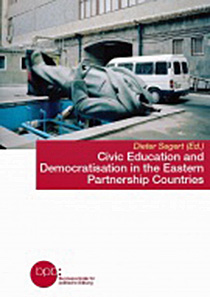
Civic Education in Eastern EuropeThe Federal Agency for Civic Education (Bundeszentrale für politische Bildung/bpb) has published the book “Civic Education and Democratisation in Eastern Partnership Countries“. The publication is available as a free e-book in English and Russian language.

Civic education is often regarded with scepticism in the formerly socialist Eastern Partnership countries. However, a vibrant civil society has developed in several states.

The texts of this volume examine the relationship between civic education and democratization in Armenia, Azerbaijan, Belarus, Georgia, Moldova and Ukraine.

The English version can be downloaded here: www.bpb.de/222223
The Russian version can be downloaded here: www.bpb.de/222930

LLLP Position Paper on Learning Participation

Learning ParticipationA clear challenge for our educational systems is to better adapt to the needs of modern societies. Today’s learners expect “complimentary chains” between formal, non-formal and informal learning, which involves better-designed innovative and collaborative learning methodologies and assessment procedures, going beyond the traditional “one-size-fits-all” approach.
These can contribute to improving learning participation, well-being and educational attainment. Read more in the new Lifelong Learning Platform position paper!

LLLP Position Paper on Learning Participation

Position Paper: Implementing Erasmus+ better!

Erasmus+The Erasmus+ programme is a unique funding opportunity and a great step forward to modernise education policies at the local, national and European level.  To embrace its full potential, the LLLPlatform believes that the programme could benefit from more clarity, a stronger lifelong learning approach and a fairer budget distribution, in order to have a greater added value.

Moreover, policy development and civil society cooperation should be better supported in order to increase its policy impact and relevance. Considered to be one of the success stories of the European construction, the programme and its successor require a bigger investment from EU Member States to broaden its positive impact. We thus strongly call for a set of adjustments on the Erasmus+ programme to improve its efficiency as well as for a stronger and more ambitious programme for 2020 building on the success of its predecessors.

LLLPlatform Position Paper Implementing Erasmus+ better

Call for Proposals: Projects that promote freedom and tolerance

Erasmus+Projects that foster inclusion, support democratic values and prevent radicalisation are invited to apply for funding under an Erasmus+ Call for Proposals published this month.

The Call is linked to the Paris Declaration adopted by EU Education Ministers and Commissioner Navracsics in March 2015. The Declaration aims at promoting citizenship and the common values of freedom, tolerance and non-discrimination through education.

Funding for these projects falls under Erasmus+ Key Action 3: Support for policy reform. Applications must address specific objectives, including (but not limited to):

  • Preventing gender inequality
  • Supporting teachers and educators in dealing with diversity
  • Fostering mutual understanding and respect among people with different ethnic or religious backgrounds.

Activities must start between 1 and 31 December 2016. The deadline for applications is 30th May 2016, noon CET.

For more information visit the Call for Proposals here.